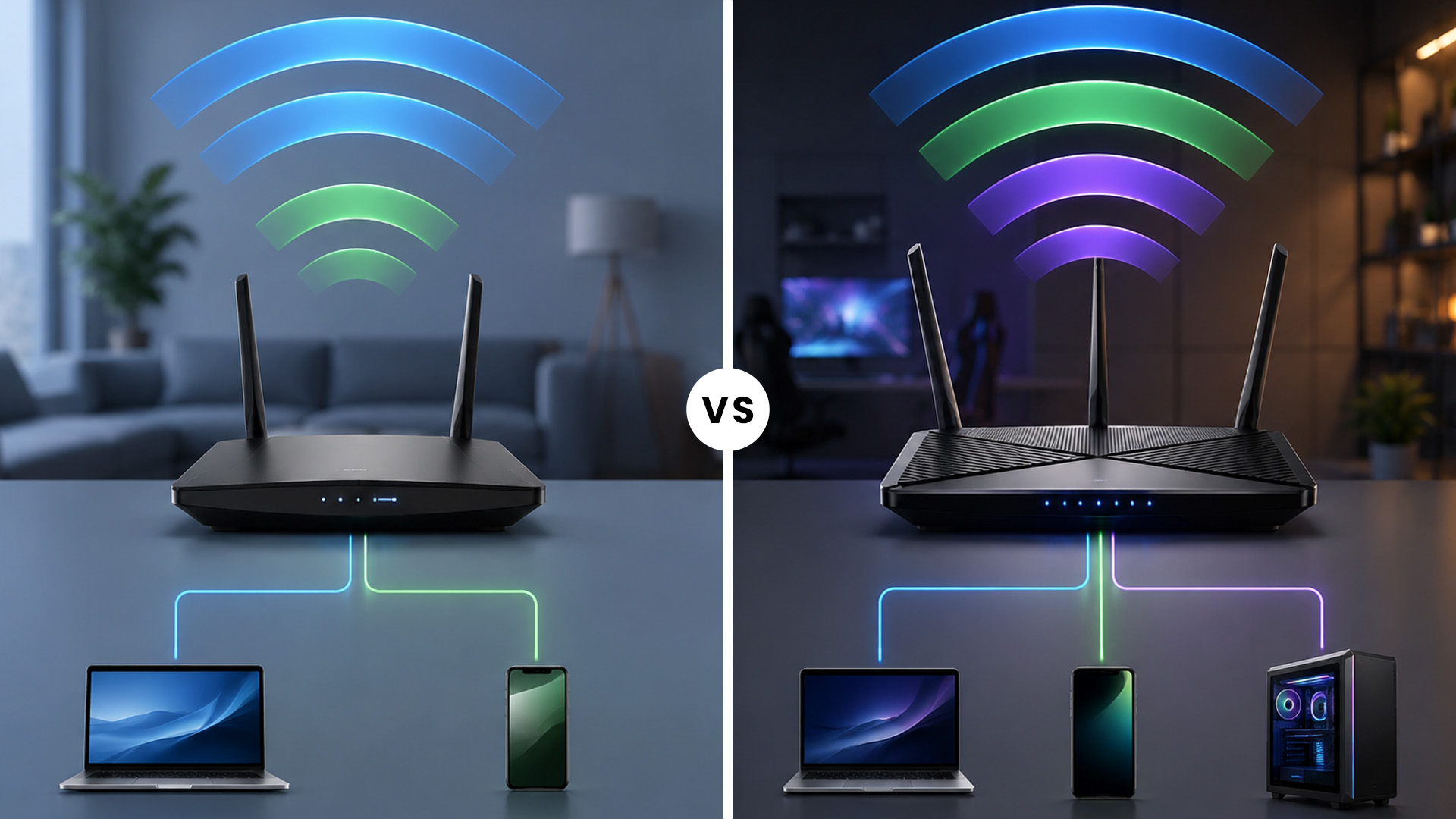
Choosing the right Wi-Fi router can feel confusing, especially with so many technical terms thrown around. Two of the most common types you’ll come across are dual-band routers and single-band routers. If you’re wondering which router to buy for your home or office, understanding the real difference between these two can save you money and years of frustration with slow internet.
This guide breaks down the dual-band vs single-band router debate in plain language, so you can make a confident, informed buying decision, whether you’re setting up a small apartment network or a busy household full of connected devices.
Single-Band Router Explained: How It Works and Who It’s For
A single-band WiFi router broadcasts a Wi-Fi signal on only one frequency, 2.4GHz. This was the standard for home internet routers for many years, and it still works well for basic needs.
A single-band router offers wide signal coverage that travels well through walls and floors, and it usually costs less than a dual-band model. Its main drawback is speed. Because every connected device shares the same single channel, performance drops quickly as more gadgets join the networking device. It’s also more prone to interference from household electronics like microwaves and cordless phones, which operate on the same frequency.
Single-band routers work best for smaller homes, budget setups, or households where only a few devices connect at once, such as browsing, emailing, and light streaming.
Dual-Band Router Explained: Why It Outperforms Single-Band Models
A dual-band router broadcasts two separate Wi-Fi signals at the same time, one on the 2.4GHz band and another on the 5GHz band. This gives users more flexibility and significantly better performance for modern internet usage.
By combining longer-range 2.4GHz coverage with the faster 5GHz band, a dual-band WiFi router spreads devices across two channels instead of forcing them all onto one. This reduces congestion, so laptops, smart TVs, and phones aren’t all competing for the same bandwidth. It’s the reason a dual-band Wi-Fi router feels noticeably smoother during gaming, streaming, and video calls, even when several people are online at once. The trade-off is a slightly higher price compared to single-band models.
2.4GHz vs 5GHz: Understanding the Core Difference
The real difference between dual-band and single-band routers comes down to how they use these two frequencies.
The 2.4GHz band travels farther and penetrates walls more effectively, which makes it reliable for smart home devices and rooms located far from the router. However, it’s slower and more crowded, since many household gadgets also use this frequency. The 5GHz band moves in the opposite direction: it delivers much faster speeds and less interference, but its range is shorter and it struggles to pass through thick walls.
A single-band router only gives you the 2.4GHz experience. A dual-band router lets you switch between both, depending on what you’re doing and where you are in your home.
Dual-Band Router for Multiple Devices, Gaming, and Streaming
If your home has several people using laptops, smartphones, smart TVs, and gaming consoles at the same time, a dual-band router for multiple devices is generally the smarter investment.
For gaming, a dual-band WiFi router reduces lag by moving your console or PC to the less crowded 5GHz band. For streaming, it supports smoother 4K playback without constant buffering. And for anyone working from home, video calls stay stable even when other devices are downloading files or streaming in the background at the same time.
For single users with light internet needs, this level of performance may not be necessary, which is where single-band routers still hold value.
Dual-Band vs Single-Band Router: Weighing the Pros and Cons
A dual-band router delivers faster speeds on 5GHz, causes less network congestion, performs better with multiple devices, and is more future-proof as smart homes grow more connected. On the downside, it costs more than a single-band model, and its 5GHz signal has a shorter range through walls.
A single-band router, by comparison, costs less, covers small spaces well, and is simple to set up for basic use. Its limitations show up under heavy use, where speeds slow down, interference becomes more common, and performance struggles once multiple devices connect at the same time.
Which Router Should You Buy?
Start by thinking about how many devices connect to your Wi-Fi daily. More than five active devices usually calls for a dual-band router. Next, consider whether you stream, game, or take video calls regularly; if so, dual-band is the better fit. If your home is small with basic internet needs, a single-band router may be enough. Finally, factor in your budget: single-band WiFi routers are more affordable upfront, but dual-band routers often deliver better long-term value.
For most homes today, a dual-band Wi-Fi router is the safer, more future-ready choice, especially as more smart devices, streaming platforms, and remote work tools become part of daily life.
Where to Buy Best Wi-Fi Router for Home Use in Bangladesh
When searching for the best Wi-Fi router for home in Bangladesh, reliability and after-sales support matter just as much as specifications. Internet usage patterns in Bangladesh have shifted heavily toward streaming, online classes, and remote work, making dual-band routers increasingly popular for home networks that need to support fiber and broadband connections without slowdown.
For buyers comparing dual-band router price in Bangladesh against single-band router price in Bangladesh, it helps to shop from a source that offers genuine products, transparent pricing, and dependable service. Star Tech is a trusted router shop in Bangladesh, known for offering a wide range of dual-band and single-band routers to suit different budgets and household needs. With EMI facilities and nationwide home delivery, Star Tech makes it easier for customers across the country to upgrade their home network without visiting a physical store.